Why GRC Should Be Your Next Sculpting Medium: a manifesto for large-scale ambition

Updated: 4 days ago
For too long the art world has treated concrete as “foundational” — literally the plinth, the base, the building material — while bronze wears the crown. That old hierarchy is a materials-history quirk, not an artistic inevitability. Glassfibre-Reinforced Concrete (GRC / GFRC) lets the same sculptural instincts used for clay and wax run to full scale: self-curing, thin-shell, richly texturable and a fraction of the weight of bronze. It’s time GRC was recognised as a legitimate fine-art medium — not an economical compromise.
Below, we set out the practical, financial and environmental reasons sculptors should take GRC seriously, and how artists can get started without selling their souls (or a kidney).

1. Monumental scale without the kiln (or the mortgage)
Clay modellers know the pain: kiln size, sectional firing, breakage and unbelievable costs when you try to scale up. Bronze solves the breakage problem — but at a huge monetary and carbon premium.
GRC’s advantages for scale:
No firing. GRC cures at ambient temperature (or with gentle steam) so you can go big without specialised kilns.
Thin shells. GRC achieves structural thinness (often 12–25 mm for decorative shells) by relying on AR-glass reinforcement and composite action; that means huge geometric presence without massive mass.
Lightness. Concrete density ≈ 1,800–2,100 kg/m³; bronze ≈ 8,700–8,900 kg/m³. For the same volume, bronze can be ~4–5× heavier. Lower weight means simpler lifts, cheaper installation and less structural support. (See LCA and transport discussion below.) IEA+1
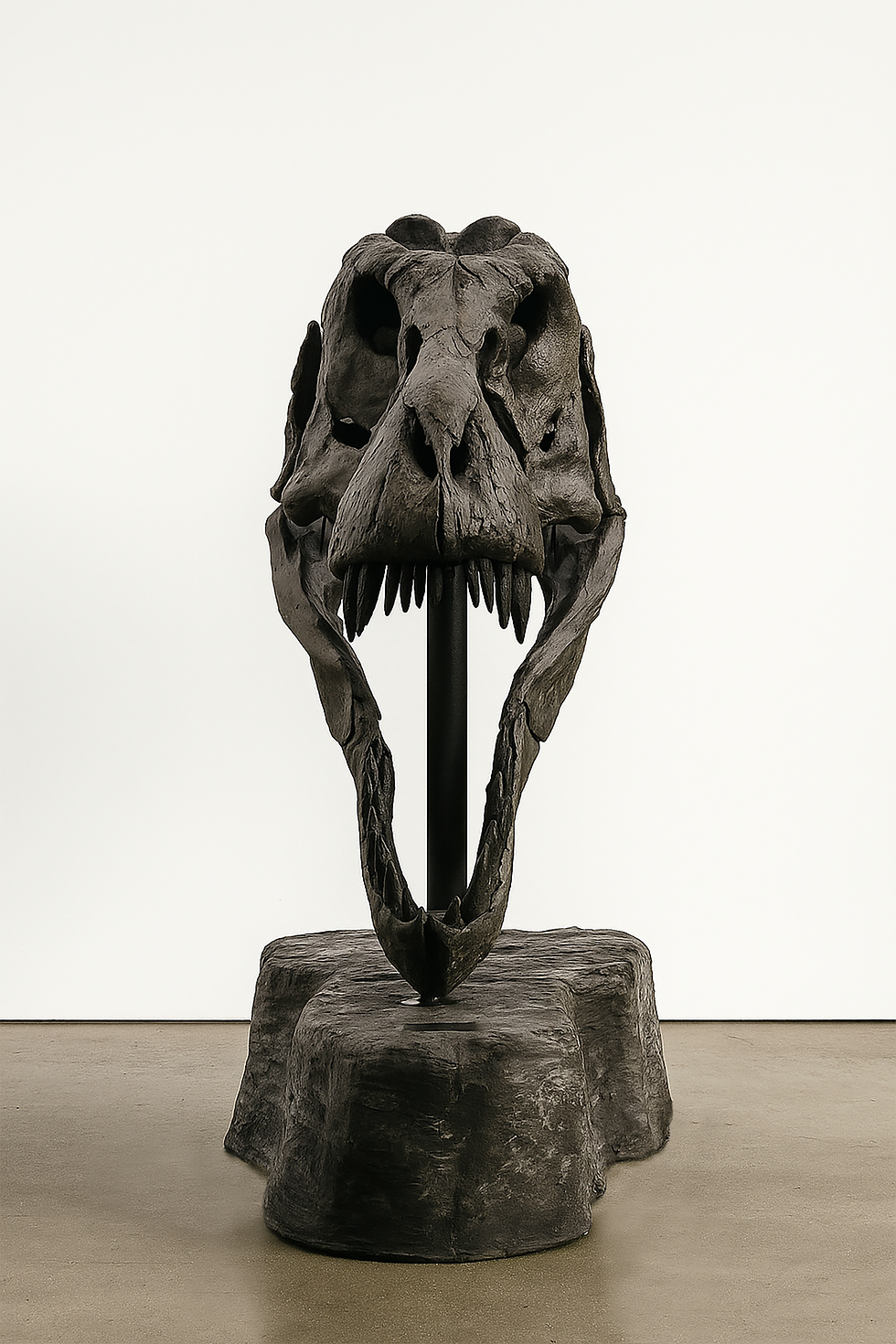
Example: Unfound’s Ronald Rex — a true-scale skull (1.55 m long × ~0.9 m wide plus base). We wanted the bronze look and tactile finish but couldn’t justify the foundry spend or the crane logistics of a solid-metal piece. GRC gave us the scale, the surface depth and the bronze-like patina without the prohibitive founder-and-metal bill.
2. The skill ceiling is high — but the barrier to entry is lower
People assume “concrete is easy.” In practice, high-quality GRC sculpture requires:
sculptural technique (exactly the same eye and hand as clay or wax)
materials knowledge (cement chemistry, admixtures, polymer modifiers)
composite practice (fibre orientation, lamination, thin-shell detailing)
finishing: pigments, patination, sealants and sacrificial coatings
That intellectual load is not trivial — arguably greater than casting wax or sending a mould to a foundry, because the sculptor must control both form and a living material system. The win is cost accessibility: a capable artist can kit up a modest workshop and iterate economically, whereas a comparable bronze commission typically involves large foundry fees and long lead times.
3. Sustainability: GRC often beats bronze on cradle-to-grave carbon
This is crucial for public commissions: councils, clients and grant bodies are increasingly using carbon budgets or embodied carbon rules when specifying public art and urban furniture.
The broad life-cycle picture:
Raw-materials: Cement carries a calcination carbon penalty (limestone → clinker), but the mass of material required for thin-shell GRC sculpture is small. Bronze’s primary ingredient — copper — is carbon-intensive to smelt and refine. International analyses place primary copper and tin extraction at much higher CO₂ per kg than cement per kg (and bronze is heavy). IEA+1
Manufacturing energy: Cement manufacture is energy-intensive (thermal energy for kilns), but copper smelting and alloying consume many times more energy per tonne. Modern LCA work shows bronze (virgin alloy) can be several times the cradle-to-gate CO₂ of an equivalent volume of GRC. IEA+1
Transport: because bronze is ~4–5× denser, shipping and lifting emissions for the same visual volume are much higher for bronze. Trading Economics
End-of-life: bronze has a well-established high scrap value and recyclability; concrete is down-cycled (crushed into aggregate) rather than closed-loop recycled. This is the area where bronze scores strongly. circularecology.com
Representative cradle-to-grave figures (synthesised from the LCA literature and embodied-carbon databases) show typical GRC sculpture in the low thousands of kgCO₂e per m³ vs many thousands for virgin bronze. To make that concrete: typical representative numbers used in recent LCAs and industry summaries are roughly 1,200–1,800 kgCO₂e/m³ for GRC and 7,500–9,000 kgCO₂e/m³ for virgin bronze (50%-recycled bronze sits between those extremes). I prepared a simple bar chart/table summarising those representative numbers right after this text. IEA+2glassfibreeurope.eu+2
Bottom line: for most public artworks and architectural sculptures GRC is the lower-carbon option — especially once you account for lighter transport and the realistic design life (many concrete pieces last several decades with appropriate detailing). Bronze becomes competitive only if the foundry guarantees very high recycled content and a very long expected service life, or if cultural/heritage value specifically requires metal. IEA+1
4. Cost comparison (practical, current to NZ market)
Costs vary wildly with size, complexity and location. Still, a few facts are robust:
GRC materials & small workshop kit are cheap enough for an emerging sculptor to buy and learn with. Professional GFRC premixes and rovings are sold in New Zealand for studio-scale use. A basic hopper gun and compressor are a one-off studio cost. In addition to this, a skilled GRC fabricator can batch their own low-carbon mix designs with complete control over the mix properties depending on desired application technique, texture, weather conditions etc.
Bronze casting in small-volume fine art foundries typically runs from several thousand dollars for small pieces to tens of thousands (or far more) for life-size, highly detailed sculptures — that total includes mould-making, lost-wax work, metal, labour and finish. NZ foundries exist, but artists still report five-figure costs for life-size bronze commissions.
That starter pack gets an artist mixing, spraying and laminating studio-scale work. Materials cost per m³ of GFRC in studio conditions depends on mix design and waste; but 20-kg bags make small batches for experimentation and can be scaled up accordingly.
By contrast, bronze: industry and foundry reports show life-size bronze commissions commonly land in the low-five to six-figure range (USD/NZD dependent) because of labour-intensive lost-wax work, metal cost and finishing. For example, small bronzes can be a few thousand USD, but detailed life-size pieces are frequently USD $10k–$50k+ before transport and installation. (Prices depend on method, alloy, and whether the foundry quote includes mould-making and patination.)
5. Surface, finish and expression — GRC is not “grey, flat, boring”
GRC is a designer’s dream when it comes to surface:
integral oxide pigments produce deep, permanent colour
polish, exposed aggregate and micro-terrazzo finishes give a tactile aesthetic that reads like stone or aged metal at a glance
patination techniques, faux-metal coatings and inlaid details (bronze claws, stainless teeth, glass eyes) let artists aim for a “metal” look without the metal price tag
In short: a GRC surface can be deliberately “concrete-looking”, or it can convincingly mimic bronze, stone, ceramic or composite finishes. That versatility is why Unfound used GRC for Ronald Rex — we achieved scale and the bronze-esque presence the concept needed, without the foundry budget.
6. Practical recommendations for artists and commissioners
Design for thinness where you can. A 10–25 mm shell with internal ribs or a light substrate gives huge volume for little mass.
Specify low-carbon binders where possible. LC3 or blended cements, or geopolymer binders, can substantially reduce the carbon of the cement binder (industry reports and pilot projects show major % reductions). Check suppliers and request LCA data. World Economic Forum
Detail for durability. Use appropriate cover, CO₂ / chloride mitigation strategies, and surface sealants to reach multi-decade service lives. With good detailing GRC outdoor pieces commonly reach 50+ years. the University of Bath's research portal
Consider hybrid choices. Bronze highlights (small inserts) + GRC body is a pragmatic hybrid that saves cost and carbon while delivering the look and heritage signals clients sometimes want.
Ask for supplier LCA data when bidding for public works. Many clients now require embodied-carbon reporting; GRC suppliers can usually provide material CO₂ numbers or point you to ICE/industry databases. circularecology.com
Final thought
Bronze and GRC are different tools in the artist’s kit. Bronze has an unmatched cultural and recycling pedigree; GRC offers a contemporary answer to scale, texture, agility and carbon responsibility. For sculptors who want to make large, expressive work without foundry lead-times, or for public commissions serious about embodied carbon, GRC is not a “cheap” compromise — it’s a medium in its own right.