What Landscape Architects Don't Know About GRC (But Should)

Updated: 4 days ago
When most people hear the word "concrete" in a design context, a familiar picture forms: grey, flat, pockmarked slabs. Heavy. Industrial. Inflexible. The sort of material that goes underneath things, not on top of them.
That picture is not entirely wrong for traditional precast concrete. But it has almost nothing to do with glass fibre reinforced concrete.
If you are a landscape architect or designer and GRC is not already part of your material vocabulary, this post is for you. Because the gap between what most designers assume GRC is and what it can actually do is enormous, and that gap is costing projects the finishing details that take them from good to genuinely extraordinary.

First, Let's Reset the Concrete Assumption
Glass fibre reinforced concrete (GRC, also known as GFRC or glassfibre reinforced concrete) is a thin-shell composite material. It is not a poured slab. It is not precast block. It shares a name with conventional concrete but almost nothing else.
GRC is sprayed or hand-packed over moulds and formwork at thicknesses typically between 10 and 25 mm, reinforced with alkali-resistant glass fibres rather than rebar. The result is a material that can hold virtually any three-dimensional form, take any surface texture, accept integral colour pigments throughout its full depth, and do all of that at a fraction of the weight of solid concrete or natural stone.
That last point is not a minor footnote. It changes what is structurally feasible, what can be retrofitted into existing spaces, what can be cantilevered, suspended and floated. It changes the whole conversation.
What GRC Can Actually Do in a Landscape Setting
This is the part that tends to stop landscape architects mid-sentence when they encounter it properly for the first time.
Water features. Bowls, troughs, rills, cascades, pond linings, fountain basins and freestanding water walls can all be fabricated in GRC. Fully waterproof, salt-water stable and available in any form the design requires. No liner visible. No compromised geometry. No weight penalty loading up a terrace or rooftop.
Floating stair treads. One of the most popular GRC applications in contemporary landscape and garden design. Cantilevered treads that appear to hover above a planted bank or water feature, with no visible substrate. Light enough to allow steel fixing methods that genuinely cannot work with natural stone or solid concrete at equivalent dimensions.
Planters. Large-scale planter boxes, tapered urns, low plinth planters and complex organic forms, all fabricated to precise dimensions, with drainage incorporated at the time of manufacture. Custom shaped to fit specific spatial constraints or match existing built elements. At a weight that makes installation and future repositioning practical.
Decorative screens, partition walls and wind panels. Perforated or patterned GRC panels used as area dividers, privacy screens, wind-break features and decorative boundaries. Can be fabricated with any surface pattern, lattice geometry or bas-relief detail. Integrated into steel frames or self-supporting depending on scale and configuration.
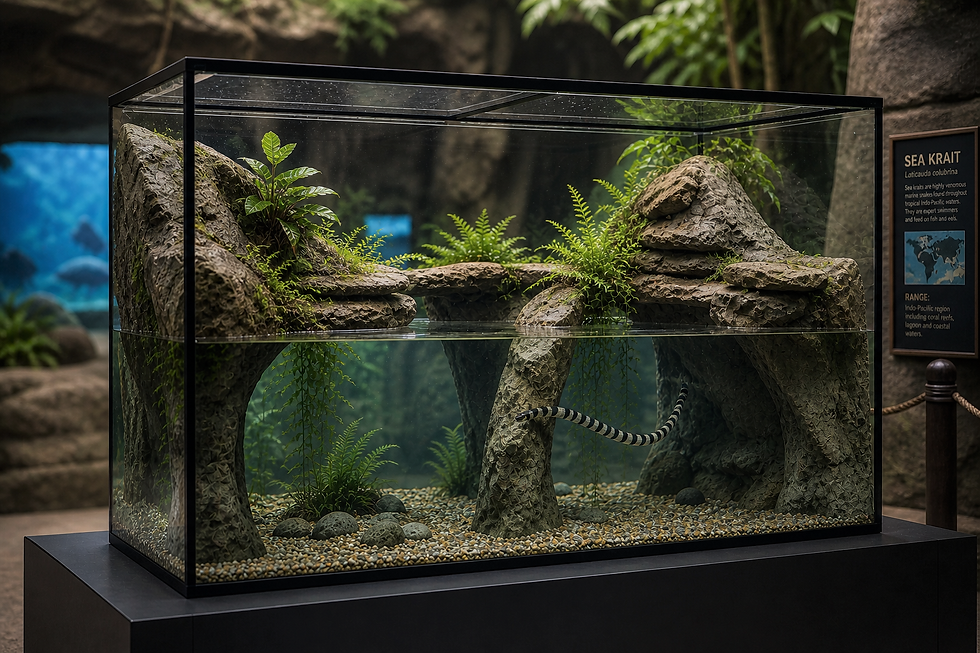
Imitation rockwork. Where natural boulders are not feasible due to access constraints, structural loading limits, budget or availability, GRC rock forms provide a convincing alternative. Lightweight, durable, available in any geological texture or colour reference. Particularly useful on rooftop gardens, elevated terraces and tight-access urban courtyards where delivery of natural stone is simply not practical.
Outdoor kitchen and BBQ surrounds. Benchtops, splashbacks, sink basins, storage plinths and full kitchen frames in GRC. Fully weatherproof, heat-stable when correctly detailed, and available in any finish from polished and refined to raw and textural. A material that holds its own aesthetically against the highest-spec external joinery and stone cladding.
Bird baths, bowls and garden vessels. Sculptural standalone pieces that function as both practical garden elements and focal point objects. Custom proportioned, custom finished. Not catalogue items.
Sculpture, follies and statement focal points. Abstract forms, figurative pieces, topographic elements, architectural follies and bespoke art objects for residential and commercial landscape settings. GRC is a genuine sculptural medium, not just a building product. Complex organic geometry, fine surface detail and monumental scale are all within its range.
Cladding panels and feature walls. Textured surface panels for retaining walls, boundary walls and feature facades within landscape settings. Stone effects, timber board effects, raw aggregate finishes and smooth architectural faces, all fabricated off-site and fixed on-site.
And that is far from an exhaustive list.
GRC vs Traditional Precast Concrete: The Honest Comparison
Traditional precast concrete has its place. For structural elements, retaining walls and civil infrastructure, it is often the right choice. But for the design-led, visually prominent elements that define the character of a landscape project, its limitations are real.
Weight. Precast concrete is dense and heavy. Large pieces require crane lifts, reinforced substructures and significant site access. GRC pieces of equivalent visual scale can weigh 75 to 80 per cent less, making them practical where precast simply is not.
Form freedom. Precast is produced in standard moulds. Custom profiles exist but add significant cost and lead time. GRC is inherently a custom fabrication process. Every piece begins from a mould or direct sculpt that reflects exactly what the design requires.
Surface finish. Standard precast has a limited finish range and notorious pin-hole porosity. GRC's surface is dense, non-porous and readily textured to virtually any reference: honed stone, split rock, riven timber, smooth board-form or polished architectural faces. Finishes are consistent and repeatable across multiple pieces in a project.
Colour. Precast colour is surface-applied or limited to a narrow range of cement and aggregate combinations. GRC colour is integral throughout the material via oxide pigments blended into the mix. No painted surface layer that weathers and fades. No repainting programme. The colour is the material.
Long-term performance. Precast in exposed landscape conditions can stain, spall and develop surface carbonation over time. Well-fabricated GRC with appropriate UV-stable PU sealing resists staining, does not corrode and does not weather the way traditional precast does in outdoor conditions. It will not rot in water contact. It will not degrade at the edges. It is designed for the outdoors.
Designed Around Your Palette, Not Ours
There are no standard colours or off-the-shelf finishes at Unfound. Every project brief is different, and the material response should be too.
Working from material samples, design references, mood boards or existing site elements, GRC pieces can be developed in any colour, any texture and any geometric form. Whether the project palette calls for a warm limestone feel, a dark basalt finish, a smooth white concrete aesthetic or something altogether more expressive, the material can be taken there.
For landscape architects and designers working across residential, commercial and public realm projects, GRC offers a level of design specificity that standard manufactured products simply cannot match.
Let's Talk About Your Next Project
If you have a landscape project in progress, or one coming up, and you have been trying to find a material solution that genuinely fits the design intent rather than compromising it, we would very much like to hear from you.
At Unfound we work directly with landscape architects and designers from early concept through to fabrication and delivery. No minimum order. No catalogue constraints. Just a conversation about what you are trying to achieve and whether GRC is the right way to achieve it.
We are confident it will be.