


GRC Theming for Zoos, Aquariums and Museums: Habitats and Displays Built to Last
- Unfound Creations

- May 21
- 6 min read
There is a moment in every great exhibit when a visitor stops, looks around, and forgets they are standing inside a building. The rock face feels ancient. The tree root looks like it has been there for centuries. The cave smells faintly of earth. That moment of immersion does not happen by accident. It is the result of skilled design, expert fabrication and, more often than not, the right material choice.
For theming designers, habitat designers, display designers and the institutions that commission their work, glass fibre reinforced concrete (GRC / GFRC) is quietly becoming the material of choice for exactly this kind of work. And for good reason.
What Is GRC and Why Does It Matter for Theming?
GRC (also known as GFRC or glassfibre reinforced concrete) is a thin-shell composite material made from a cementitious matrix reinforced with alkali-resistant glass fibres. Unlike standard concrete, GRC can be sprayed, hand-packed or cast into virtually any shape, at thicknesses as low as 10 to 25 mm, producing pieces that are remarkably strong yet a fraction of the weight of solid concrete, natural stone or timber.
For an in-depth look at the material science behind GRC, see our post Why GRC Should Be Your Next Sculpting Medium.
What makes GRC genuinely exceptional for theming environments is not just one property in isolation. It is the combination of all of them together.
The Case for GRC in Themed Environments
Lightweight Without Compromise
Natural rock is heavy. A single boulder large enough to create a convincing habitat feature can weigh several tonnes, placing enormous structural demands on floors, tanks and support frames. Timber, while lighter, brings its own problems (more on that shortly).
GRC shells achieve the same visual mass at a fraction of the weight. Large rocky outcrops, cliff faces, cave formations and submerged boulders can all be fabricated as hollow, thin-walled GRC pieces that are practical to transport, install and reposition. For retrofitting into existing enclosures or tanks where load limits matter, this is not a minor advantage. It is often the deciding factor.
Sculpted to Any Form
GRC is fabricated over moulds or directly sculpted by hand, which means its shape is limited only by the imagination of the designer. Realistic sandstone textures, basalt columns, gnarled root systems, coral structures, riverbed stones, timber grain effects and ancient masonry can all be faithfully reproduced in GRC at any scale. A habitat designer working on an African savanna enclosure and a display designer recreating a Jurassic riverbank are both working within the same material's capabilities.
Complex undercuts, organic curves, fine surface detail and large monolithic forms are all achievable. Custom pieces can be designed to fit precisely within an existing tank, enclosure or display area, making GRC equally suited to new-build projects and refurbishment work.
Waterproof and Salt-Water Stable
For aquariums, marine exhibits and any habitat that involves water, material durability is paramount. Timber will rot. Untreated steel will corrode. Many foam-based theming products degrade in prolonged water contact, particularly in salt-water environments.
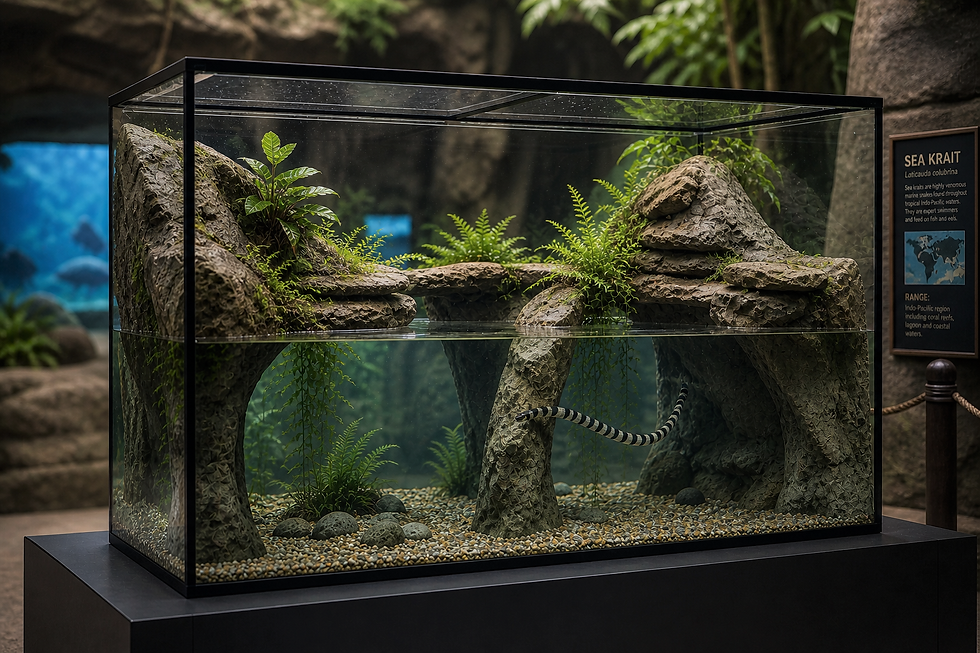
GRC is inherently waterproof. When fabricated correctly, it does not absorb water, will not swell, crack or delaminate in wet conditions, and is stable in both fresh and salt water. Submerged rockwork, underwater cave systems, partially immersed log effects and tidal zone theming are all well within GRC's capabilities. The material can be fully submerged without any compromise to structural integrity or surface finish.
This makes GRC particularly valuable for aquarium exhibit design, reptile and amphibian habitats, penguin and seal enclosures, and any other display that requires permanent or intermittent water contact.
No Rot, No Corrosion, No Weathering
One of the persistent frustrations of organic theming materials is their lifespan. Real timber eventually rots or splits. Natural rock chips, stains and becomes a biosecurity concern. Resin-based products can yellow and degrade under UV exposure.
GRC does not rot. It does not corrode. Used externally or in humid enclosures, it will not soften, warp or break down over time the way timber and polymer products do. With appropriate detailing, GRC theming installations routinely achieve service lives of several decades, making the upfront investment in quality fabrication genuinely cost-effective over the life of an exhibit.
UV Stable with Integral Colour
When high-quality polyurethane (PU) sealers are applied and allowed to fully off-gas before introduction to any environment, GRC achieves excellent UV stability. This prevents surface bleaching, chalking and colour fade in externally situated or sunlit displays.
Critically, the colour in GRC theming work is integral. Oxide pigments are blended directly into the cementitious matrix, meaning the colour is through the full depth of the material. There is no painted surface layer to chip, peel or require repainting. The aged ochre of a sandstone canyon, the dark grey of a basalt formation or the warm brown of a timber grain effect will remain consistent for years without ongoing maintenance.
Applications by Sector
Zoos and Wildlife Centres
Zoo habitat design has become increasingly sophisticated, driven by animal welfare standards, visitor engagement expectations and the operational realities of animal management. GRC is well suited to meet all three demands simultaneously.
Rocky outcrops, cliffs and ledges for climbing species, den structures, water features, submerged boulders and naturalistic soil and root effects can all be fabricated in GRC to match the specific environmental requirements of a given species. Because GRC pieces can be custom-sized to fit within existing enclosures, habitat upgrades are practical without major structural modification.
Pieces can be designed to be animal-safe, with non-toxic materials and smooth internal edges where required, and can incorporate drainage points, hidden enrichment cavities, water-jet fittings and other functional elements as part of the fabrication process.
For wildlife centres displaying taxidermied animals or working with diorama-style educational exhibits, GRC provides realistic environmental backdrops and ground-level habitat features that far outperform painted MDF, polystyrene or resin alternatives in terms of longevity and visual quality.
Aquariums and Marine Exhibits
Aquarium exhibit design demands materials that can perform continuously in wet, salt-water and chlorinated environments, often under high visitor scrutiny and close-range inspection. GRC's combination of waterproofing, structural strength and sculptural flexibility makes it an outstanding choice for this sector.
Custom GRC rockwork can be fabricated to fit within existing tank infrastructure, whether for a large open-water display or a smaller species-specific habitat. Coral-effect structures, tidal cave systems, seabed rocky outcrops, kelp forest bases and riverbed habitats can all be produced in GRC with high levels of surface realism.
For species that require specific microhabitats, such as crevices for moray eels, ledges for flatfish camouflage or hollow caves for octopus, these features can be designed directly into the GRC structure rather than added as afterthoughts.
GRC rockwork for aquarium use can also be fabricated to support, conceal or integrate with filtration equipment, feed points and monitoring access panels, reducing the visual clutter of operational infrastructure within the display.
Museums and Heritage Centres
Museum exhibit fabrication increasingly calls for high-quality environmental replicas that can contextualise artefacts, specimens and educational content within a believable physical setting. GRC is particularly well suited to this work.
Fossil replicas (think full-scale dinosaur bone beds, skull specimens, embedded stone tools or ancient shoreline formations), geological survey cross-sections, archaeological site reconstructions and natural history diorama environments can all be produced in GRC at any scale. A GRC replica of a trilobite-bearing limestone bed or a hand-axe-era flint scatter can be fabricated to exacting dimensional accuracy, pigmented to match the original material, and installed in a gallery environment without the weight, fragility or conservation concerns of authentic geological specimens.
For natural history museums in particular, the combination of GRC's structural confidence, realistic texture capability and low maintenance profile makes it a pragmatic alternative to real rock, timber and organic material in permanent or semi-permanent display installations.
Theme Parks and Visitor Attractions
Theme park theming demands material that can deliver high visual impact across large areas, withstand constant public interaction, survive outdoor weathering and require minimal ongoing maintenance. GRC ticks every one of those boxes.
Rocky canyon walls, castle stonework, jungle ruins, prehistoric landscapes and fantasy environments are all well within GRC's fabrication range. Because theming for visitor attractions often involves very large-scale installations, GRC's lightweight nature significantly reduces structural engineering requirements and installation costs compared to natural stone or solid concrete construction.
The integral colour, UV stability and weatherproof surface finish mean that GRC theming remains visually consistent over years of heavy public use, without the repainting programmes and repair cycles that painted polystyrene or rendered blockwork alternatives typically require.
Custom Fabricated by Unfound Creations
At Unfound Creations, we fabricate bespoke GRC theming pieces for each project from scratch. There are no off-the-shelf catalogue items. Every piece begins with an understanding of the specific environment, the species or subject it is designed to support, and the dimensional constraints of the space it needs to fit within.
Our low-carbon GRC mix design prioritises both environmental responsibility and material performance. Pieces are sculpted, moulded or a combination of both, depending on the complexity and scale of the project. Surface finishes are developed to match reference imagery, existing environments or the creative direction of the design team.
We work directly with habitat designers, theming designers, display designers, zoo curators, aquarium designers and museum exhibit managers, at any stage of a project, from early concept through to final fabrication and delivery.
If you are working on a zoo habitat, aquarium exhibit, museum installation or theme park theming project and would like to explore what is possible in GRC, we would love to hear from you.


